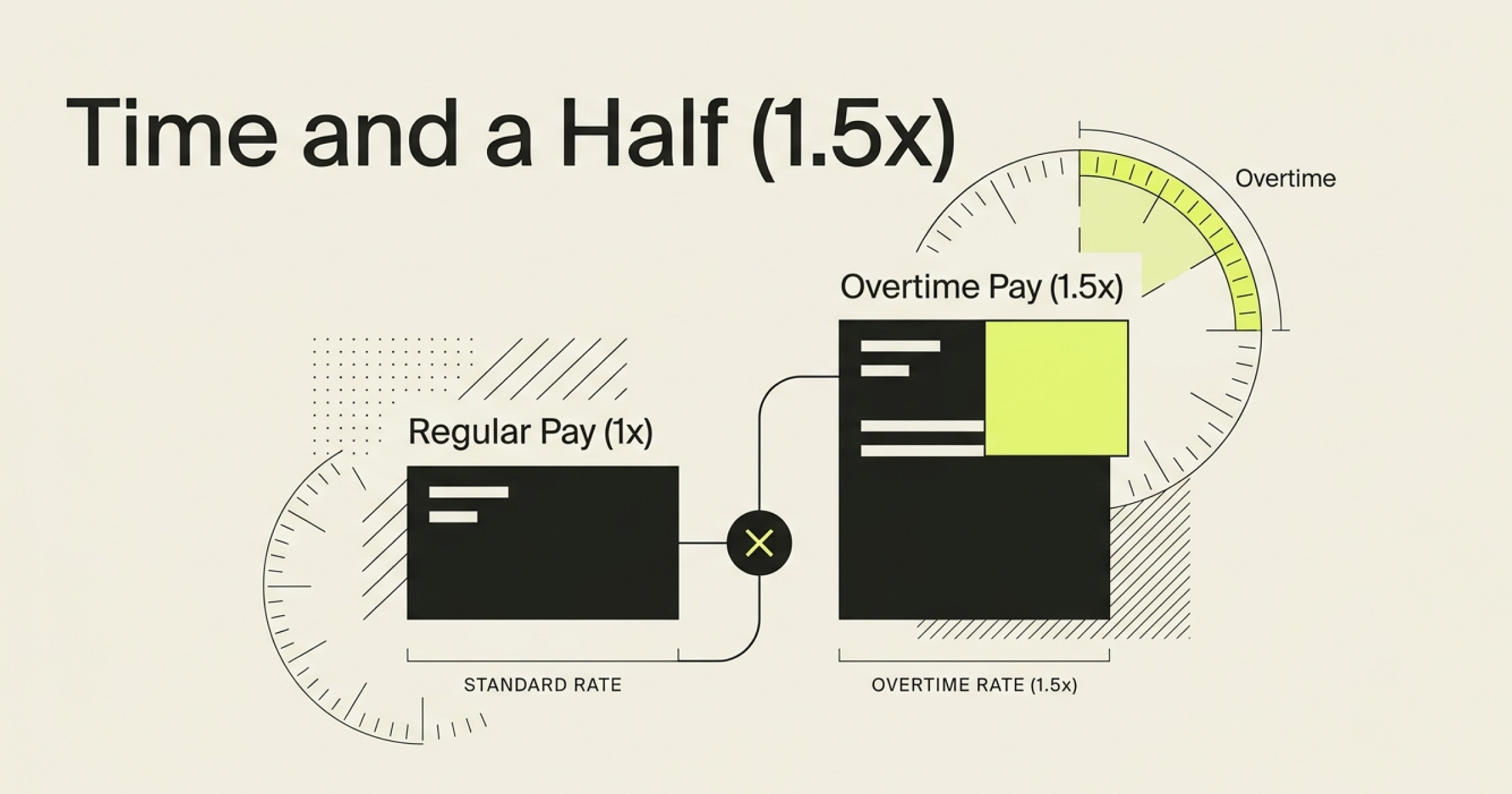
To work out overtime pay, multiply your regular rate by 1.5, then multiply that by your overtime hours. That part is easy.
The part that goes wrong is deciding which hours count, and which rate the 1.5 applies to. That rate is often not the number on your contract.
The formula
Overtime pay = regular rate x 1.5 x overtime hours. Your gross for the week is your regular pay plus that.
Say you earn $20 an hour and work 46 hours in one week. The first 40 hours pay $800. The other 6 hours pay $30 an hour, so $180. Your gross for the week is $980, before tax and deductions.
Which hours count as overtime
Under the Fair Labor Standards Act, if you are covered and non exempt, you get at least one and a half times your regular rate for hours past 40 in a workweek.
A workweek is a fixed block of seven days that repeats. It does not have to start on a Monday. But your employer cannot move it around to avoid paying you.
Each week stands on its own. If you are paid every two weeks, the two weeks are not averaged. Work 30 hours one week and 50 the next and you are owed 10 hours of overtime, not none.
Federal law does not give you overtime just for working past 8 hours in a day, or for weekends and holidays. Some states do. It depends on where you work.
Your regular rate is often higher than your hourly wage
This is the one that costs people the most money.
Overtime is calculated on your regular rate, not the hourly wage on your contract. The regular rate is built from most of what you actually earned that week.
- Production and attendance bonuses you were promised generally go in.
- Shift differentials and most commissions generally go in.
- Discretionary bonuses and real gifts generally stay out.
- Money paid back to you for expenses stays out.
Here is what that does to the number. You earn $20 an hour and pick up a $100 production bonus in a 45 hour week. Your straight time pay is 45 x $20 = $900, plus the $100 bonus, so $1,000. Your regular rate is $1,000 / 45 = $22.22 an hour.
Your overtime comes off $22.22, not $20. If your employer used $20, you were paid short.
Step by step
- Check that you are non exempt, so you qualify at all.
- Add up the hours you actually worked in one fixed workweek.
- Split them into the hours up to 40 and the hours above it.
- Work out your regular rate, including any pay that belongs in it.
- Multiply the regular rate by 1.5, then by your overtime hours.
- Add your regular pay and your overtime pay together.
Double time
Double time is not a federal rule. It comes from state law, a union agreement, or your employer's own policy. If a different multiplier applies to you, put it in the formula where the 1.5 sits.
Mistakes that cost real money
- Averaging two workweeks inside one biweekly pay period.
- Using the base wage when a bonus should have raised the regular rate.
- Counting paid holiday or vacation hours toward the 40 hour line. That time is paid, but it is not time worked.
- Being treated as exempt because of a job title. Your actual duties and how you are paid decide that, not what the title says.
- Approved work done off the clock. That time generally still counts.
Run your own numbers
The Overtime Pay Calculator splits regular and overtime hours and gives you the gross. If you are starting from daily start and end times, build the week in the Time Card Calculator first. And if the overtime check itself looked smaller than you expected, is overtime taxed more explains what is actually happening.
These calculators do arithmetic. They cannot tell you whether you are exempt, which payments belong in your regular rate, or what your state adds on top. Your payroll team or a qualified advisor can settle those.
Frequently asked questions
How do I calculate time and a half?
Multiply your regular rate by 1.5, then multiply by the hours you worked past 40 that week. At $20 an hour, time and a half is $30, so 6 overtime hours pay $180.
Is overtime based on my hourly wage?
Not always. It is based on your regular rate, which also includes things like promised bonuses and shift differentials. That makes it higher than your posted wage in a week where you earned any of them.
Can my employer average two weeks to avoid overtime?
No. Each workweek is judged on its own, even when you are paid every two weeks. 50 hours in one week is overtime regardless of how few hours you worked in the other.
Do I get overtime for working more than 8 hours in a day?
Not under federal law, which counts hours past 40 in a week. Some states have a daily rule, so check the rules where you actually work.
Sources
- Fact Sheet #23: Overtime Pay Requirements of the FLSA, U.S. Department of Labor, Wage and Hour Division. Checked .
- 29 CFR 778.109: The regular hourly rate of pay, Electronic Code of Federal Regulations. Checked .
- Overtime Pay, U.S. Department of Labor, Wage and Hour Division. Checked .