Rate inputs
Results update as you type. Figures are 2026 federal estimates for a sole proprietor.
If you enter existing W-2 wages, the rate covers the extra tax on this freelance work only, not the income tax on your W-2 job.
The QBI deduction assumes a sole proprietor with no business employees; above the threshold it phases to zero.
Recommended hourly rate
$82.55
Minimum viable hourly
$71.78
Day rate (8 hours)
$660.40
Monthly take-home at minimum
$5,000.00
Annual take-home at minimum
$60,000.00
- Self-employment tax
- $12,171.03
- Federal income tax
- $5,967.78
- Overhead
- $8,000.00
- Buffer built into recommended rate
- $12,920.82
- Estimated combined tax
- about 21-22%
The QBI deduction assumes a sole proprietor with no business employees; above the threshold it phases to zero.
Estimated, not tax advice. Standard deduction $16,100.00 is applied automatically. If you enter existing W-2 wages, the rate covers the extra tax on this freelance work only, not the income tax on your W-2 job. The QBI deduction assumes a sole proprietor with no business employees; above the threshold it phases to zero. State tax is a flat rate you enter, not full state brackets. No credits or itemized deductions. Not a substitute for an accountant. S-corp wages, extra deductions, and local tax can change the real rate.
Common questions
How much should I charge as a freelancer?
Charge enough that, after taxes, overhead, and unpaid time, you still keep the take-home you need. This calculator solves for that hourly rate from your target, hours, and costs. It is not a market survey, so check what similar work actually pays in your field.
How many billable hours should I use when calculating my freelance rate?
Use hours you can actually invoice, not hours you are awake. A common starting point is 48 weeks and about 25 billable hours a week, which is 1,200 hours a year. Cut that further for holidays, sick days, admin, and slow months. If you count 40 hours a week, you will underprice the time you cannot bill.
What should my freelance hourly rate cover?
It should cover your take-home target, self-employment tax, income tax, business overhead, and the hours you do not bill. The recommended rate also adds the savings buffer you enter. If a platform takes a fee, the hourly figure is raised so that fee does not eat the take-home you set.
How are taxes accounted for in the freelance rate?
The calculator searches for the gross profit that leaves your target after self-employment tax and estimated federal income tax. It does not divide by one minus a flat tax rate. If you enter existing W-2 wages, the rate covers the extra tax on this freelance work only, not the income tax on your W-2 job. State tax is a flat rate you type in, not a full state return.
Should I charge hourly, daily, or by project?
Use hourly when the scope can grow. Use a day rate when a client buys a full day; this page shows an 8-hour day from the recommended hourly rate. Use a project fee when the work is defined: estimate the hours, multiply by your hourly rate, and add a margin for revisions. The tax math does not change with the billing label.
Runs in your browser. Your entries are calculated on this device. Ziannah does not store the values you enter here.
Related tools
Explore all toolsHourly to Salary Calculator Convert an hourly wage to weekly, monthly, and annual pay, or convert salary back to hourly.
Overtime Pay Calculator Estimate regular pay, overtime pay, total hours, and gross earnings for a pay period.
Time Card Calculator Add a weekly time card with breaks, regular hours, overtime, and estimated gross pay.
How it works
How this freelance rate is built
The rate is not take-home divided by hours. Taxes are not a flat percentage, so the calculator searches for the gross that produces your target after those taxes.
What you are solving for
You enter the money you want to keep, plus yearly business costs. The calculator finds self-employment profit that, after tax, still covers that combined need. That profit is then divided by billable hours. A platform fee, if any, is applied to the hourly rate so the fee does not eat the take-home you set.
Self-employment tax
Self-employment tax is Social Security at 12.4% and Medicare at 2.9% on 92.35% of net profit. Social Security stops at the 2026 wage base of $184,500, reduced by any W-2 wages already taxed. Medicare has no wage cap. If net earnings from self-employment are under $400, this tax is zero. Half of the Social Security and Medicare tax (not Additional Medicare Tax) is deductible when estimating income tax. If you enter existing W-2 wages, the rate covers the extra tax on this freelance work only, not the income tax on your W-2 job.
Income tax and QBI
Federal income tax uses 2026 brackets and the standard deduction for the filing status you pick. The QBI deduction assumes a sole proprietor with no business employees; above the threshold it phases to zero. Additional Medicare Tax of 0.9% applies when combined wages and self-employment earnings pass the filing-status threshold. State tax, if you enter a rate, is a flat estimate on taxable income, not a full state return.
This is an estimate
The result is not tax advice and not a filing. It does not model itemized deductions, dependents, credits, S-corp wages, local tax, or every QBI wage and property limit. Check the current IRS and SSA figures before you rely on a number, and use a tax professional for decisions that affect what you charge or file.
Related reading
Read the blog
Article
Is overtime taxed more? No, and here is the real reason
Overtime is taxed at the same rate as your normal pay. Here is why your payslip looks wrong, and the new deduction that cuts what you owe from 2025 to 2028.
Article
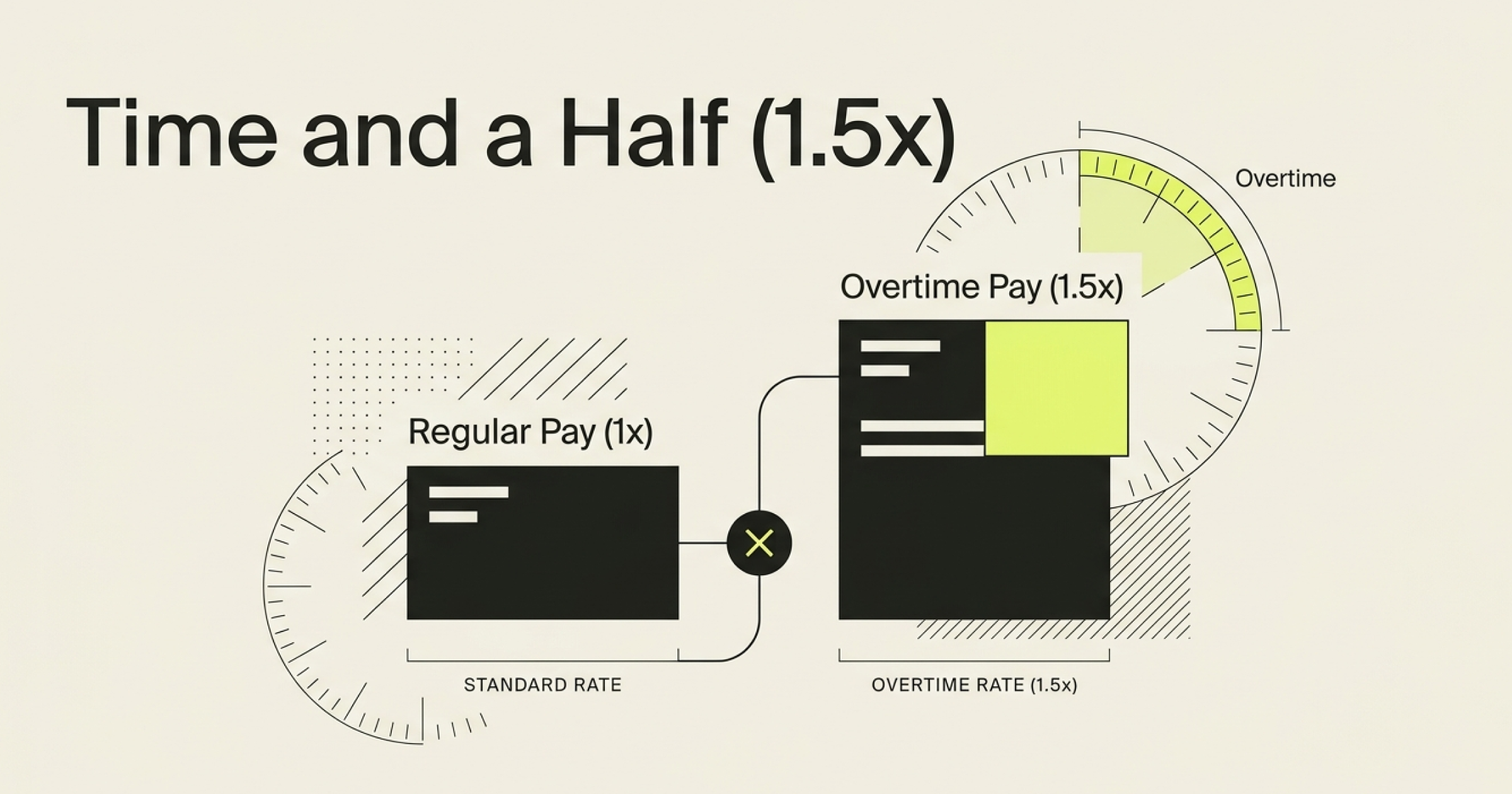
How to Calculate Overtime Pay (Time and a Half)
Multiply your regular rate by 1.5 and then by your overtime hours. The hard part is knowing which rate to use, because it is often higher than your wage.

Article
Minutes to Decimal Hours: Payroll Conversion Chart
Divide minutes by 60. Here is the chart, the four values worth memorizing, and the rounding habit that quietly costs you minutes every week.